
Collection
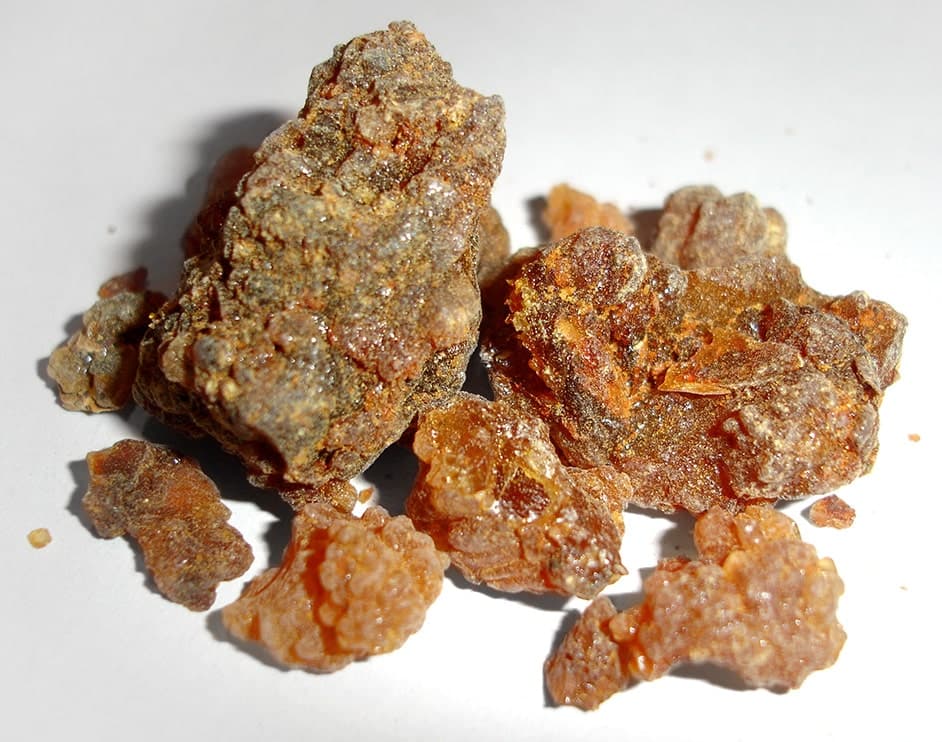
Myrrh, Ethiopia
Product code: Not provided
No sizes are currently available.
About this product
For further information about this product or to inquire about larger quantities, please send us an email and we will get back to you as soon as possible. The availability and price of this product may vary without prior notice, if for some reason the quantity you have requested is currently unavailable, we will contact you shortly to discuss the best options to fulfill your needs.
Identity and quality
- Botanical name
- Commiphora molmol
- Origin
- Ethiopia
- Plant part
- Oleoresin
- Extraction
- Steam distilled
- Cultivation
- SAUV.
- Synonyms
- Balsamodendron myrrha
- INCI
- Commiphora myrrha resin oil
- CAS TSCA
- 8016-37-3
- CAS EINECS
- 84929-26-0
- Appearance
- Brownish liquid
- Odour
- Characteristic spicy balsamic odor
Composition and further information
Myrrh essential oil comes from the resin of a small, very thorny tree that grows naturally in the southern Arabian Peninsula, Somalia, Ethiopia, Sudan and the Republic of Djibouti. It was introduced for myrrh production in India, Pakistan and Thailand. The branches are twisted, gnarled with sharp needles. Myrrh is a resinous gum that naturally oozes from the trunk, and this is incised to activate the flow. Traditionally myrrh is used for perfumes, incense and embalming, myrrh symbolizes suffering. It was one of the three gifts brought by the Magi to the child Jesus (gold, frankincense and myrrh). Myrrh is an ancient medicine from ancient Egypt. Myrrh gives off a pleasant, camphorous, spicy and warm scent like an animal smell. In mythology: Myrrha, pregnant by her father, was driven out and found refuge in Arabia, Aphrodite changed her body into a tree and her blood into sap, Adonis was born from its trunk, from her tears flow the tears of myrrh. Main components of essential oil Sesquiterpenes: lindestrene 8%, curzerene 20%, furanoeudesma-1,3-diene 40%, beta-elemene 5%, germacrene-B, germacrene-D, gamma-elemene, alpha-selinene Furanosesquiterpenes (5 to 15%): furanoelemanes (curzerenone), furanoeudesmanes, furanogermacranes, heerabolene Dammarane-derived triterpenes: mansumbinone, 3,4-seco-mansumbinoic acid Eugenol
A word from Anny Schneider
Myrrh has been used as incense and perfume since the beginning of time. It is linked to both African and Christian rituals. During the Epiphany, it was given by the three kings to the Christ. In spiritualism, it is called the ''calming oil '' because of its capacity to purify the body, soul and surrounding spaces. Antagonistic to LDL-cholestérol it is also known to be antiseptic and to fight bactéria.
Properties — source text
Myrrh is traditionally used in Africa to treat parasitosis. Perfuming agent: Used for perfume and aromatic raw materials. Dermatology.
Suggested use
Cosmetic Scent Dermatology
Precautions for use
The essential oil is cytotoxic but not genotoxic.
References
* L’aromathérapie énergétique - Lydia Bosson * L’aromathérapie exactement - Pierre Franchomme, Roger Jolis et Daniel Pénoël * L’aromathérapie, Se soigner par les huiles essentielles - Dr Valnet
Documents and certifications
Warnings and storage
Read the product-specific precautions, safety data sheet and usage guidance before use.
- Keep out of reach of children. Do not ingest; seek urgent medical or poison-control advice after accidental ingestion.
- Avoid eyes and mucous membranes. For essential oils, follow dilution guidance and patch-test before use.
- Ask a health professional before using essential oils during pregnancy or breastfeeding, or with epilepsy or asthma.
- Stop use if an adverse reaction occurs. Follow the product-specific restrictions on sun exposure.
- Store in a closed container away from light and heat. This information does not replace medical advice.
Comments
No comments have been published yet.
Write a comment
Our team reviews comments before publication. Your public name and text will be visible. Sign in